Drawbacks of k-means
Clustering
you will notice that all the clusters
created are circular. This is because the centroids of the clusters are updated
iteratively using the mean value.
Now, consider the following example where
the distribution of points is not circular. What do you think
will happen if we use k-means clustering on this data? It would still attempt
to group the data points circularly. That’s not great! k-means fails to
identify the right clusters:

Hence,
we need a different way to assign clusters to the data points. So instead of using a distance-based
model, we will now use a distribution-based model. And
that is where Gaussian Mixture Models come into this article!
Introduction to Gaussian
Mixture Models (GMMs)
The
Gaussian Mixture Model (GMM) is a probabilistic model used for clustering and
density estimation. It assumes that the data is generated from a mixture of
several Gaussian components, each representing a distinct cluster. GMM assigns
probabilities to data points, allowing them to belong to multiple clusters
simultaneously. The model is widely used in machine learning and pattern
recognition applications.
Gaussian
Mixture Models (GMMs) assume that there are a certain number of components,
where each component is a Gaussian distribution. Hence, a Gaussian Mixture
Model tends to group the data points belonging to a single Gaussian component
together. The parameters of the mixture components, such as the means and
covariances, are typically estimated using the Expectation-Maximization (EM)
algorithm or maximum likelihood estimation techniques.
Let’s
say we have three Gaussian components (more on that in the next section) – GD1,
GD2, and GD3. These have a certain mean (μ1, μ2, μ3) and variance (σ1, σ2, σ3)
value respectively. For a given set of data points, our GMM would identify the
probability of each data point belonging to each of these mixture components.
The EM algorithm iteratively updates these parameters to maximize the
likelihood of the data, without requiring the derivative to be calculated
explicitly.
Wait, probability?
You
read that right! Gaussian
Mixture Models are probabilistic models and use the soft clustering approach
for distributing the points in different clusters. I’ll
take another example that will make it easier to understand.
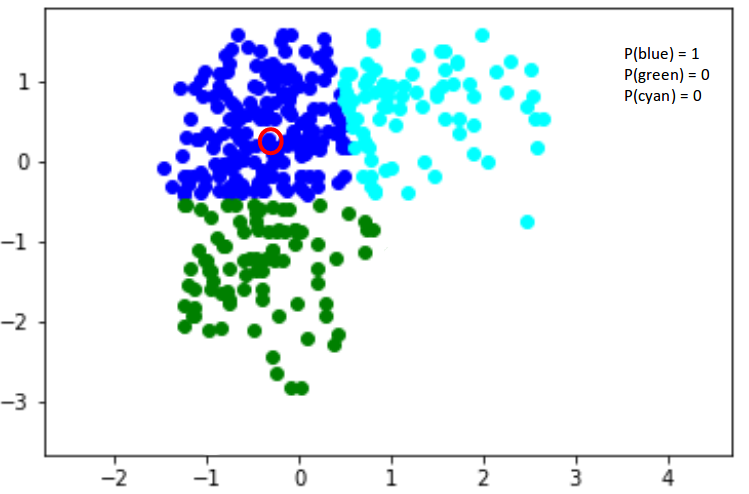
Here,
we have three clusters that are denoted by three colors – Blue, Green, and
Cyan. Let’s take the data point highlighted in red. The probability of this
point being a part of the blue cluster is 1, while the probability of it being
a part of the green or cyan clusters is 0.

and posterior probabilities of the cluster assignments given the data. An important decision in GMMs is choosing the appropriate number of components, which can be done using techniques like the Bayesian Information Criterion (BIC) or cross-validation.
Now,
consider another point – somewhere in between the blue and cyan (highlighted in
the below figure). The probability that this point is a part of cluster green
is 0, right? The probability that this belongs to blue and cyan is 0.2 and 0.8
respectively. These coefficients represent the responsibilities or soft
assignments of the data point to the different Gaussian components in the
mixture.
Gaussian Mixture Models use the soft
clustering technique for assigning data points to Gaussian distributions,
leveraging Bayes’ theorem to compute the posterior probabilities. I’m sure
you’re wondering what these distributions are so let me explain that in the
next section.

The Gaussian Distribution
I’m sure you’re familiar with Gaussian
Distributions (or the Normal Distribution). It has a bell-shaped curve, with
the data points symmetrically distributed around the mean value.
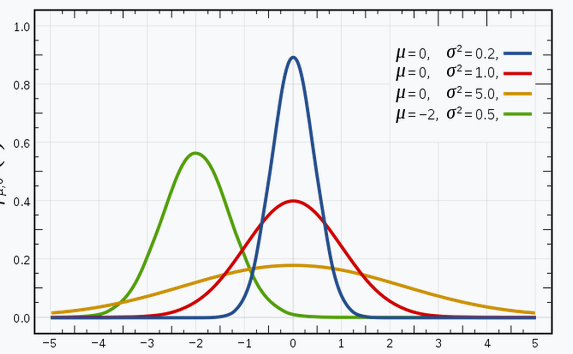
The below image has a few Gaussian
distributions with a difference in mean (μ) and variance (σ 2 ). Remember that
the higher the σ value more the spread:

Source: Wikipedia
In a one dimensional space, the probability
density function of a Gaussian distribution is given
by:

where μ is the mean and σ2 is the variance.
But this would only be true for a single
variable. In the case of two variables, instead of a 2D bell-shaped curve, we
will have a 3D bell curve as shown below:

The probability density function would be
given by:

where x is the input vector, μ is the 2D
mean vector, and Σ is the 2×2 covariance matrix. The covariance would now
define the shape of this curve. We can generalize the same for d-dimensions.
Thus, this multivariate Gaussian model would
have x and μ as vectors of length d, and Σ would be a d
x d covariance
matrix.
Hence, for a dataset with d features,
we would have a mixture of k Gaussian distributions
(where k is equivalent to the number of clusters), each having
a certain mean vector and variance matrix. But wait – how is the mean and
variance value for each Gaussian assigned?
These values are determined using a
technique called expectation maximization (EM). We need to understand this
technique before we dive deeper into the working of Gaussian Mixture Models.
Characteristics of the
Normal or Gaussian Distribution
Characteristics of the normal or Gaussian
distribution:
- It’s bell-shaped with most values around the average.
- It has only one peak or mode.
- It stretches out forever in both directions.
- Its mean, median, and mode are the same.
- Its spread is measured by its standard deviation.
- The total area under its curve equals 1.
Comments
Post a Comment